
A mountain bike light needs to do more than glow on a path. It must stay mounted over roots, survive rain, and give enough light to spot rocks, ruts, and branches ahead. You need a setup that matches the trails you ride and the length of your evening loop. Lumens measure total light output, so higher numbers usually mean a wider, brighter beam, while the beam shape decides how that light spreads across the trail.
A Fast Comparison Of The Options
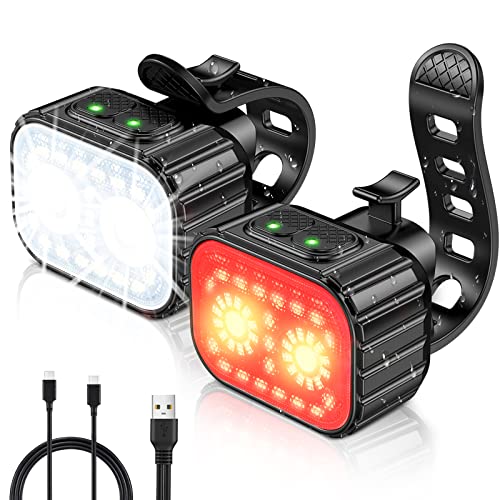
Cuvccn Super Bright Rechargeable Bike Lights Set

Suruid Super Bright LED Bike Light USB Rechargeable 5 Modes

Zewdov Rechargeable Bike Lights Night Riding Set

TioyFiuy Bike Lights Front and Back Set 9+9 Modes

Victoper Bike Light 6+4 Modes USB Rechargeable Set

Ascher Ultra Bright USB Rechargeable Bike Light Set

TioyFiuy 1200LM Bike Lights Headlight Tail Light Set
The Details Behind The Selections
The Cuvccn set suits riders who want front and rear coverage without juggling separate purchases. Two main LEDs plus 19 auxiliary LEDs give a broad pattern, and separate switches let each light run alone or together. That setup helps on forest paths where side spill matters as much as a forward beam.
Runtime is the headline here. The front light reaches up to 58 hours in slow flash mode, while the rear reaches 25 hours, and a green indicator flashes below 20 percent charge. You can mount both units by hand, with horizontal or vertical adjustment, and IPX6 describes strong protection against powerful water jets.
Reasons It Performs
- Long slow-flash runtime reduces charging frequency between rides
- Independent switches allow flexible front and rear mode choices
- Tool-free mounting speeds setup on different bikes
- IPX6 rating suits heavy rain and muddy splashes
Things To Consider
- Front battery is 1100mAh and rear is 350mAh, so rear runtime is shorter
- Many modes can take time to cycle through on the trail
Suruid takes a different route from the Cuvccn set, with a single front headlight built around output. A combined low and high beam design spreads light wider while pushing distance farther, and the stated maximum reaches 1800 lumens. That suits fast descents where spotting obstacles early matters.
The shell uses anodized aviation aluminum alloy, which helps with heat dissipation during long rides. A knob on the bracket allows quick removal in seconds, and IPX-4 covers splashes and rain rather than submersion. Five modes give options for trails, commuting, and daytime running light use.
The Value In It
- 1800 lumens supports high-speed trail visibility
- Aluminum alloy shell aids heat dissipation
- Quick-release knob simplifies removal and charging
- USB Type-C charging fits common cables
Worth Noting
- Front-only design means a separate rear light is needed
- IPX-4 offers less water protection than IPX6 models
Zewdov leans into slimness, with a 1.7cm thickness and 27g weight that barely registers on a lightweight trail bike. Both lights charge together through a 2-in-1 cable in 1 to 1.5 hours, which keeps turnaround short between rides. That matters for riders who store gear in a small hallway or apartment corner.
The headlight offers 4 modes and the taillight offers 6, including a memory function and a breathing flash mode. In most cases, a low-profile light like this suits riders who prefer minimal cockpit clutter. Elastic rubber straps attach front and rear without tools, and IP65 covers rain and fog.
Points In Its Favor
- Slim 27g design adds minimal weight to the bike
- Simultaneous charging cuts downtime between rides
- Memory function restores the last used mode
- Elastic straps fit scooters and strollers too
Trade Offs
- Compact size may limit beam spread on technical trails
- Elastic straps need a check for fit on thicker posts
Who It Suits Best
Riders with lightweight bikes who want a low-profile front and rear setup for mixed road and gentle trail use.
Where Another Pick Suits Better
Suruid Super Bright LED Bike Light USB Rechargeable 5 Modes suits riders who need higher front output for faster descents.
TioyFiuy pairs a 300lm front light with a 100lm rear light, and each side carries 9 modes with memory. That range covers steady riding, flashing for traffic, and trail use without needing a second purchase. ABS plus PS plastic keeps each unit at 35g, so weight stays low on commuter and mountain bikes alike.
A 750mAh battery gives 4 to 20 hours depending on mode, and a dual-wire cable charges both lights in 1.5 hours. Soft silicone straps install without tools and fit bikes, e-bikes, scooters, and strollers. For most riders, that flexibility makes one set work across several household items.
Everyday Wins
- 9+9 modes cover steady and flashing needs
- Dual-wire charging refills both lights in 1.5 hours
- 35g per light keeps added weight low
- Silicone straps install without tools
- Memory function restores prior mode
Minor Gripes
- 300lm front output is modest beside 1200lm options
- Runtime drops to 4 hours in brighter modes
Victoper uses an aluminum alloy body with IPX4 protection, a step up in shell material from the plastic TioyFiuy set. The front light has 6 modes, including left strong, right strong, all-on, breathing, and strobe, while the rear has 4 modes. That split-beam front pattern can help on trails where edge light matters.
At 4oz total, the pair stays portable enough to carry as a flashlight off the bike. One thing worth considering is mode complexity, since switching through six front options takes attention. Power display helps track charge level before a ride.
Good Reasons To Consider
- Aluminum alloy body suits rough trail handling
- Split front beams widen trail coverage
- Power display helps plan charging
Points To Note
- Six front modes add complexity for new riders
- IPX4 protection is splash-level, not jet-level
Made For
Riders who want a rugged front and rear pair for road, mountain, and night riding with extra mode choices.
Consider Something Else When
Ascher Ultra Bright USB Rechargeable Bike Light Set suits riders who prefer simpler four-mode control.
Ascher keeps control simple with one-touch switching across 4 modes: full brightness, half brightness, slow flashing, and fast flashing. That simplicity suits new riders who do not want to cycle through many settings in traffic. The front light rotates 360 degrees horizontally, while the rear tilts 45 degrees up and down.
The front battery is 2000mAh for 5 to 12 hours, and the rear is 330mAh for 9 to 16 hours, depending on mode. Silicone straps with four openings fit most handlebars and seatposts, and the pair totals 3.5oz. IPX4 covers rain, snow, and mud splashes.
Where It Excels
- Four modes keep operation straightforward
- 2000mAh front battery supports longer rides
- Rotating front light adjusts beam angle
- Silicone straps fit varied bar sizes
Small Caveats
- Four modes offer less tailoring than 9-mode sets
- IPX4 rating suits splashes, not heavy jets
TioyFiuy 1200LM set aims at riders who need serious output and clear charge info. Dual-button controls run independent XTE and COB beams, with an OLED battery display. Urban, suburban, and highway settings step through 500LM, 900LM, and 1200LM, plus flashing and red warning modes.
An aluminum alloy shell and IPX6 rating handle heavy rain, splashes, and off-road vibration. The mount fits handlebars from 0.72 to 1.35 inches, with a removable spacer for smaller bars. You can pop the light off for camping or emergency use, using a pull-ring or magnet mount.
What It Does Well
- 1200LM maximum supports dark trail riding
- OLED display shows battery level clearly
- Aluminum alloy shell suits rough conditions
- Removable design works beyond cycling
- Adjustable mount fits 0.72 to 1.35 inch bars
Areas To Watch
- Mount range needs a quick bar measurement first
- Multiple beam controls add a learning curve
Brightness, Runtime, and Fit: Choosing Mtb Bike Lights
Output and Beam Shape
Lumens tell part of the story, while beam shape decides where light lands. A wide COB-style beam helps on tight singletrack, and a focused beam reaches farther on fast descents. Riders logging long distances benefit from checking both output and spread, not output alone.
Runtime and Charging
Runtime ranges vary widely by mode, from a few hours on high to dozens of hours on slow flash. Your typical ride length should guide the choice, since a short commute needs less capacity than a weekend trail loop. Dual-wire charging that refills front and rear together saves time in a busy household.
Mounting and Weather Protection
Mount fit matters before a ride, especially on thicker mountain bike handlebars. IPX ratings describe water protection levels, with IPX6 handling stronger jets than IPX4 splash protection. Measure the bar at the mounting spot and confirm strap or clamp range before ordering.
Key Considerations Across These Picks
Common Shopping Slip Ups
Many shoppers focus only on maximum lumens and overlook runtime in brighter modes. Checking hours per mode prevents a short ride from ending in darkness. Measuring handlebar diameter also avoids a mount that feels loose on the trail.
What The Higher Tier Buys
Higher-tier sets often add aluminum shells, OLED displays, and stronger water ratings. Those features pay off for riders who ride in heavy rain or on rough terrain. Commuters on lit roads may find a simpler set meets the need at lower complexity.
Frequently Asked Questions
How many lumens does a mountain bike light need?
Output needs depend on speed and trail darkness, with higher lumens helping on fast descents. A wide beam matters as much as total output for spotting obstacles close ahead.
What does IPX6 mean for a bike light?
IPX6 describes protection against powerful water jets from any direction. That rating suits heavy rain and muddy splashes better than IPX4 splash protection.
How long do rechargeable bike lights last per charge?
Runtime depends on mode, battery capacity, and brightness setting. Slow flash modes last far longer than steady high modes on the same battery.
Can one set work on different bikes?
Many sets use straps or clamps that fit bikes, e-bikes, scooters, and strollers. Checking handlebar and seatpost diameter before ordering prevents fit problems.
Are front and rear lights both needed?
A front light helps see the trail, while a rear light helps traffic see the rider. A paired set covers both needs without separate purchases.
Final Thoughts
For long runtime, the Cuvccn set stands out, while the TioyFiuy 1200LM set suits demanding trails. Your riding style should decide the final call, with output, runtime, and mount fit weighed together.