
A loose gravel descent after sunset turns every weak beam into a guessing game. Riders need a front light that reaches far enough to spot roots and rocks, plus a rear light that stays visible on shared paths and roads. You need a setup that mounts without fuss, charges through USB, and keeps working in rain. The seven options below split by beam style, runtime, and mounting approach, so the right match depends on trail speed, commute length, and handlebar space.
The Choices Worth Comparing
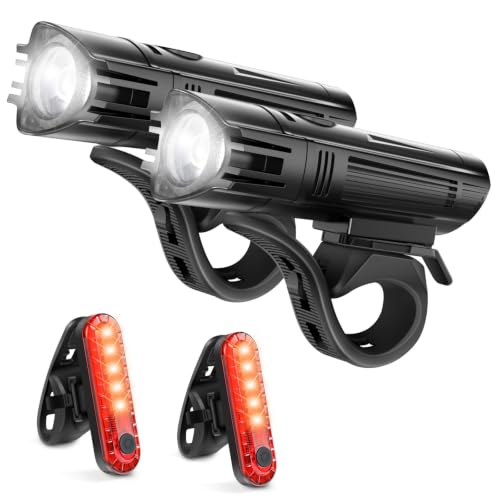
Ascher Ultra Bright USB Rechargeable Bike Light Set Black
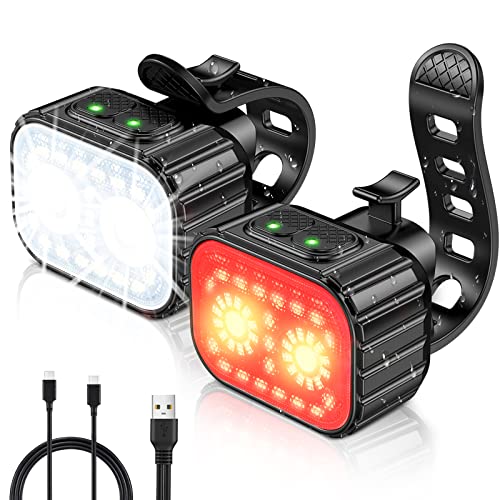
Cuvccn Bike Lights Super Bright, Rechargeable Bicycle Lights Set

Suruid Super Bright LED Bike Light, USB Rechargeable Bicycle Headlight

Zewdov Bike Lights for Night Riding, Rechargeable Bike Taillight

Vastfire 17 LED Bike Lights 5000 Lumen, Super Bright Bicycle Light

Ascher Ultra Bright USB Rechargeable Bike Light Set Kids

1200LM Bike Lights for Night Riding, Headlight and Tail Light Set
The Strengths Of Each Pick
Commutes along unlit paths suit this paired setup, with a 300 lumen front light for seeing ahead and a rear light for visibility behind. You get four modes on each unit, from full brightness to slow and fast flashing, switched with one touch. A 2000 mAh battery in the headlight and a 330 mAh battery in the taillight keep the sizes modest.
Silicone straps with four openings fit most seat posts, and a bracket secures the front unit to the handlebar. The IPX4 rating covers splashes and light rain, and a red indicator signals low power on the headlight. In our view, the straightforward controls make this a calm choice for riders who want basic coverage without extra complexity.
Key Advantages
- Front and rear lights in one set for two-way visibility
- Four modes cover steady light and flashing needs
- Tool-free removal for charging and storage
- Low-power indicator on the headlight
Things To Consider
- IPX4 suits splashes, not sustained downpours
- Smaller taillight battery limits flashing runtime
Each unit pairs two main LEDs with 19 auxiliary LEDs, and independent switches let main and auxiliary sections run separately. Your front light offers four main modes and your taillight offers six, so flashing patterns can be tuned for road traffic or trail use. That split control is the main difference from the Ascher set above.
The front battery holds 1100 mAh and the rear holds 350 mAh, with slow flash runtime listed at 58 hours and 25 hours respectively. An indicator flashes green below 20 percent charge, and the IPX6 rating adds stronger rain protection than IPX4. One thing worth considering: the many combinations take a moment to learn, though memory mode restores the last setting.
What Pays Off
- Separate switches for main and auxiliary LEDs
- Long slow-flash runtime on both lights
- IPX6 rating with covered USB port
- Memory function restores last mode
- Tool-free buckle mounting
Worth Noting
- Mode combinations need practice to master
- Recharge after three months idle for best performance
- Horizontal or vertical orientation needs manual adjustment
Who It Suits Best
Riders who want many flashing options and long runtime for regular night trips.
Where Another Pick Suits Better
Vastfire 17 LED Bike Lights 5000 Lumen suits riders who prioritize a wide, high-output beam over mode variety.
Speed on dark singletrack calls for reach, and this front-only headlight reaches 1800 lumens with combined low and high beams. You’ll notice the wider spread compared with the 300 lumen Ascher front light, which matters at higher pace. Five modes cover different trail and commuting scenes.
An anodized aluminum alloy shell aids heat dissipation, and an aluminum bracket with a knob locks the unit in place. A quick release knob at the base removes the light in seconds, and USB Type-C charging simplifies powering up. The IPX4 rating handles rain, though riders in heavy downpours may prefer the IPX6 or IPX7 options later in this list.
What Stands Out
- 1800 lumen output with low and high beam combination
- Aluminum alloy shell and bracket for rugged trails
- Quick release for fast removal
Trade Offs
- Front light only, rear light sold separately
- IPX4 rating is lighter than IPX6 and IPX7 rivals
Suruid Super Bright LED Bike Light, USB Rechargeable Bicycle Headlight
Packing for a weekend trip favors gear that disappears into a pocket, and this set measures 1.7 cm thick and weighs 27 g. The slim profile suits riders who carry lights for camping or travel rather than leaving them mounted all season. Both units charge together in 1 to 1.5 hours through a shared cable.
Four headlight modes and six taillight modes include a memory function and a breathing flash pattern for rear visibility. Elastic rubber straps attach to front and rear, and the IP65 rating covers rain and fog. Battery retention reaches up to seven months, with a suggested top-up after three months idle.
Bright Spots
- 27 g weight and 1.7 cm thickness for easy carrying
- Simultaneous charging of both lights
- IP65 rating for rain and fog
- Memory function for taillight modes
Minor Gripes
- Elastic straps suit standard posts, check diameter first
Rough forest trails punish loose mounts, and this set answers with a dual-nut structure and aluminum bracket with silicone buffer pads. Your headlight uses 17 LEDs for 5000 lumens and a wide beam, paired with a rear warning light. Four modes include floodlight, spotlight, high beam, and strobe.
A high-capacity battery runs up to 16 hours, and an LCD display shows charge level in real time. USB-C input supports fast charging, and USB-C output can charge a phone in an emergency. The aerospace-grade aluminum alloy body carries an IPX7 rating, the strongest water protection in this list.
What Works In Its Favor
- 5000 lumen wide beam from 17 LEDs
- LCD display shows exact battery level
- USB-C output for emergency phone charging
- IPX7 rating for heavy rain and dust
- Dual-nut mount resists loosening on bumps
Room For Improvement
- Larger body needs clear handlebar space
- Mounting hardware includes screws and wrench
- High output suits open trails more than busy streets
Family rides need lights that move between bikes without tools, and this set weighs 3.5 oz total. You can shift the front light horizontally through 360 degrees and tilt the rear light 45 degrees up or down. Four modes cover full brightness, half brightness, slow flashing, and fast flashing.
The front battery lasts 5 to 12 hours depending on mode, and the rear battery lasts 9 to 16 hours. Silicone straps with four openings fit most handlebars and seat posts, and the IPX4 rating covers rain, snow, and mud splashes. Compared with the first Ascher set, this version adds the rotation details and runtime ranges.
Notable Gains
- Adjustable front rotation and rear tilt
- Stated runtime ranges for both lights
- Tool-free silicone straps
Points To Note
- IPX4 rating limits use in heavy rain
- Runtime drops sharply on full brightness
Made For
Families and casual riders who swap lights between bikes and ride at moderate speed.
Look Elsewhere When
Cuvccn Bike Lights Super Bright suits riders who want IPX6 sealing and longer flash runtime.
Camping trips often need a light after the ride ends, and this set detaches in seconds for that second job. You can hang it from a pull-ring in a tent, stick it to a car hood with a magnet for repairs, or run it as a red warning light on a walk. Dual-button controls separate XTE and COB beams, where COB means a wide, flat panel of LEDs.
Output reaches 1200 lumens in Highway mode, with Urban at 500 lumens and Suburban at 900 lumens. Eight functions span normal and COB modes, including strobe and constant red. An aluminum alloy body with IPX6 rating handles heavy rain and off-road vibration, and an OLED display shows battery status.
A Strong Showing
- Magnet, pull-ring, and handlebar mounting options
- Separate XTE and COB beam controls
- OLED battery display
- IPX6 aluminum alloy body
Softer Spots
- Handlebar fit limited to 0.72 to 1.35 inches
- Mount needs measuring before ordering
Key Attributes That Matter on Night Rides
Beam Output and Spread
Lumens measure total light output, while beam shape decides where that light lands. A wide flood beam suits slow trails and campsites, and a focused spot beam suits faster descents. Match output to speed, then check mode options for flashing visibility on roads.
Runtime and Charging
Battery capacity in mAh affects runtime, but mode choice changes drain sharply. Flashing modes stretch hours, and full brightness shortens them. USB-C charging is faster and more common than older ports, so check the cable type before a trip.
Mounting and Water Protection
Your handlebar diameter decides mount compatibility, and a removable spacer adds flexibility. Water ratings climb from IPX4 for splashes to IPX7 for immersion. Riders in wet climates benefit from IPX6 or IPX7, while dry-climate riders can prioritize beam and weight.
Key Considerations Across These Picks
Common Shopping Slip Ups
Many shoppers compare lumens alone and ignore beam shape, runtime at full brightness, and handlebar fit. Measure the mounting area first, then match the water rating to local weather.
What The Higher Tier Buys
Higher output, stronger sealing, and metal bodies raise cost through materials and sealing effort. The upgrade pays off for frequent off-road riding in rain, and matters less for short dry commutes.
Frequently Asked Questions
What lumen level suits mountain bike night riding?
Higher output suits faster trails, with 1200 to 5000 lumens in this list covering varied speeds. Beam shape matters as much as output for spotting obstacles early.
Front light only or a front and rear set?
A set covers visibility from both directions, which helps on shared paths and roads. Front-only units suit riders who already own a rear light.
How should water ratings be read?
IPX4 covers splashes, IPX5 and IPX6 cover stronger water exposure, and IPX7 covers immersion. Choose the rating that matches typical rain on local routes.
How long do these batteries last?
Runtime depends on mode, with flashing modes lasting far longer than full brightness. Check the stated hours for the mode planned for most rides.
Will the mount fit a specific handlebar?
Measure bar diameter at the mounting point before ordering. Removable spacers and silicone straps widen fit, but limits still apply.
Final Verdict
For fast, dark trails, the Vastfire set brings the widest high-output beam and strongest sealing. For everyday commutes, the Ascher sets keep things simple and tool-free. Match beam, runtime, and mount fit to the routes planned, and night riding gets far more predictable.