
A flat tire before a ride wastes time and kills momentum, and a weak pump makes topping up tires a chore. Presta valves, the narrow valves common on road and many mountain bikes, need a pump head that seals without adapters. You need a floor pump that holds steady on the floor, reads pressure clearly, and matches the valves on your bikes.
Garage storage shapes the choice as much as pressure does. A tall pump needs vertical space, while a shorter design tucks beside a bench or behind a door. Your setup benefits from matching gauge size, hose length, and valve fit to the bikes you own most often.
The Choices Worth Comparing

BV Bike Pump 160 PSI Smart Valve Head
GIYO Bike Floor Pump GF27 3 inch Dual Scale Gauge

Park Tool PFP-10 Home Mechanic Floor Pump

LEZYNE Steel Floor Drive 3.5 220 PSI Pump

CXWXC Bike Floor Pump Digital Gauge 140 PSI Black
Schwinn Air Center Floor Pump 160 PSI

Topeak JoeBlow Sport III 160 PSI Pump
The Details Behind The Selections
Short length defines this pump. At 16.25 inches, the BV Bike Pump 160 PSI Smart Valve Head fits in a closet, car trunk, or corner behind a door, which suits apartment storage. You get 160 PSI capacity for road tires and sports balls from a manual, handheld design.
The valve head reverses between Presta and Schrader, so mixed bikes in one household share one pump. An ergonomic handle helps during longer top-ups, and the compact barrel means more strokes for high-volume mountain bike tires. For most garages, that trade-off feels fair for portability.
The Helpful Details
- 160 PSI ceiling covers road, hybrid, and ball inflation
- Reversible head handles Presta and Schrader valves
- 16.25-inch length stores in tight spaces
- Ergonomic handle supports repeated pumping
Things To Consider
- Short barrel needs more strokes for wide tires
- Reversing the head takes a moment between valve types
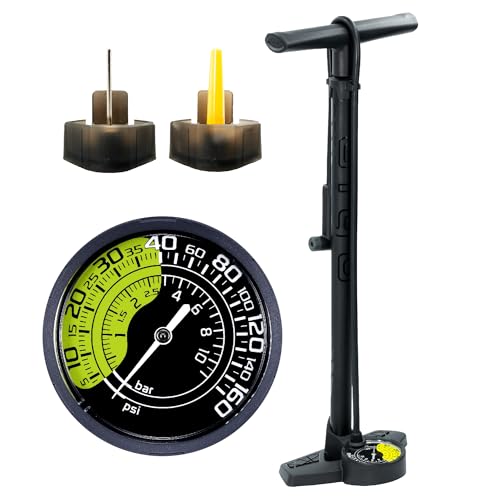
Gauge design sets the GIYO apart. The 3-inch dual-scale dial reads in 1 PSI steps from 0 to 40 for mountain, gravel, and fat tires, then switches to 5 PSI steps from 40 to 160 for road tires. You can dial low pressures more precisely than a single-scale dial allows.
A thumb-touch lock secures the valve with one hand, and the head fits Presta and Schrader without adapters. A steel barrel reaches 160 PSI, and included needle and ball inflator add home versatility. In our view, the low-range precision matters most for riders who run lower pressures daily.
Useful Touches
- Dual-scale gauge improves low-pressure accuracy
- One-handed thumb lock speeds valve connection
- Steel barrel handles 160 PSI
- Needle and ball inflator included for sports balls
- Adapter-free head fits Presta and Schrader
Worth Noting
- Road-range steps are coarser at 5 PSI
- Extra accessories need storage space
Who It Suits Best
Riders with both mountain and road bikes who check low pressures often.
Where Another Pick Suits Better
LEZYNE Steel Floor Drive 3.5 220 PSI Pump suits road riders needing pressures above 160 PSI.
Workshop stability leads this design. Extra-large foot pads keep the Park Tool PFP-10 Home Mechanic Floor Pump planted during hard strokes, and a long hose reaches valves on a bike in a stand. A large gauge stays readable from standing height.
The locking universal head adjusts to Presta and Schrader stems, and 160 PSI covers most road and mountain setups. Unlike the compact BV model, this pump prioritizes stance over portability. For most home workshops, that extra footprint feels worthwhile.
Key Advantages
- Extra-large foot pads improve stability
- Long hose reaches bikes in stands
- Large gauge reads easily at a glance
- Universal head fits Presta and Schrader
Trade Offs
- Large pads need more floor space
- 160 PSI ceiling limits track tire use
Pressure ceiling changes the conversation here. The LEZYNE Steel Floor Drive 3.5 220 PSI Pump reaches 220 PSI, well above the 160 PSI limit on most other picks in this list. Road and track riders running narrow, high-pressure tires get headroom that 160 PSI models lack.
A smaller-diameter barrel makes high pressures easier to reach, and the 3.5-inch analog gauge reads clearly. Painted steel barrel, machined aluminum base, and varnished wood handle give a refined feel. You pay for that build in size and weight at 1616g with 665mm height.
A Favorable Mix
- 220 PSI suits road and track tires
- 3.5-inch gauge reads with precision
- Smaller barrel eases high-pressure pumping
- Extra-long hose reaches stand-mounted bikes
- ABS-1 Pro chuck fits Presta and Schrader
Minor Gripes
- 665mm height needs tall storage space
- 1616g weight makes moving it less casual
Digital reading is the hook. The CXWXC Bike Floor Pump Digital Gauge 140 PSI Black shows pressure on an LCD that switches among PSI, BAR, KPA, and KG/CM2. Households using different standards can match the display to tire markings without mental conversion.
A twin head fits Presta and Schrader, a T-shaped handle aids grip, and a wider plastic base with rubber anti-skid pad adds stance. High-volume strokes speed inflation for mountain and hybrid tires. Depending on storage space, the wider base may need a flatter spot than narrower pumps.
Notable Upsides
- Digital LCD switches four pressure units
- Twin head fits Presta and Schrader
- Anti-skid base pad improves stance
- Ball needle and cone included for inflatables
Small Caveats
- 140 PSI ceiling sits below 160 PSI rivals
- Wider base needs a flat storage spot
Made For
Households that prefer digital numbers and switch pressure units.
Consider Something Else When
Park Tool PFP-10 Home Mechanic Floor Pump suits riders wanting a larger analog gauge and 160 PSI.
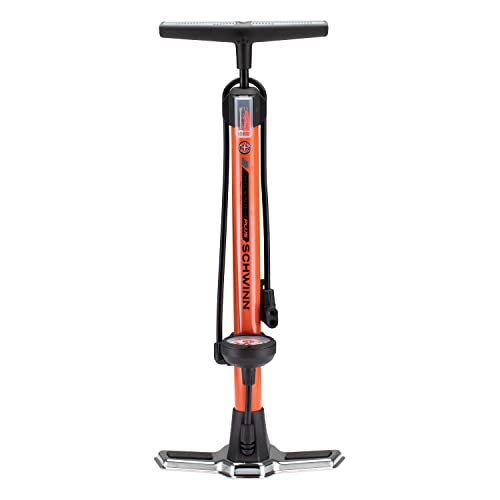
Simplicity helps at home. The Schwinn Air Center Floor Pump 160 PSI uses a dual head for Schrader and Presta valves with a red and green indicator showing readiness to inflate. That color cue helps younger riders connect the head correctly.
A wide steel base adds stability, a soft grip handle aids comfort, and a longer barrel reduces stroke count. Pressure options span 100, 120, or 160 PSI depending on version, with an easy-to-read gauge. Needle and cone attachments extend use to balls and inflatables.
The Case For It
- Red and green cue simplifies valve connection
- Wide steel base steadies pumping
- Soft grip handle improves comfort
- Needle and cone cover balls and inflatables
Points To Note
- Pressure ceiling varies by version chosen
- Basic styling offers fewer gauge refinements
Daily use shapes this design. The Topeak JoeBlow Sport III 160 PSI Pump pairs a durable steel barrel and base with a 3-inch top-mounted analog gauge for clear readings. An oversized padded handle reduces hand fatigue during frequent top-ups.
The TwinHead DX5 fits Presta, Schrader, and Dunlop valves, and a 360-degree rotating extra-long hose reaches awkward valve angles. Ball and bladder needles plus a hose dock add tidy storage. Compared with the Schwinn, this pump adds Dunlop fit and a larger gauge for serious road, gravel, and mountain use.
Everyday Advantages
- Steel barrel and base support frequent use
- 3-inch gauge reads clearly from above
- TwinHead DX5 fits three valve types
- Extra-long rotating hose reaches valves easily
- Hose dock keeps storage tidy
Honest Caveats
- 160 PSI ceiling excludes track setups
- Steel build adds weight for carrying
What Matters Most Before Choosing Floor Pump Cycling
Pressure Ceiling and Gauge Readability
Road tires often need pressures near 100 PSI, while track setups push higher. A 160 PSI ceiling covers most road and mountain use, and 220 PSI adds headroom for narrow tires. Gauge size and scale spacing matter at low pressures, where a 1 PSI step helps more than a coarse dial.
Valve Fit Without Extra Parts
Presta and Schrader valves differ in width and shape, and a head that fits both saves hassle in mixed households. Dunlop support, found on the Topeak model, adds value for certain imported bikes. Check the head type against every bike in the garage before deciding.
Stance, Hose, and Storage Footprint
Wide foot pads and a steel base resist tipping during hard strokes. A long hose reaches a valve on a bike in a stand or on a rack, while a short hose forces repositioning. Measure vertical storage space, since tall pumps like the LEZYNE model need clearance beyond floor width.
Barrel Diameter and Stroke Effort
A wider barrel moves more air per stroke, which speeds wide mountain tires but feels harder at high pressure. A narrower barrel trades volume for easier high-pressure pumping. Your tire mix should drive that choice more than headline pressure alone.
Key Considerations Across These Picks
Common Shopping Slip Ups
Shoppers often chase the highest PSI number and ignore gauge steps, hose length, and base width. That leads to a pump that reaches pressure but reads poorly at low settings or tips during use. Matching gauge scale and stance to daily tires prevents that mismatch.
When Paying More Pays Off
Higher-tier models add steel construction, larger gauges, longer hoses, and broader valve fit. Those details pay off for frequent riders, stand work, and mixed bike collections. Occasional riders gain less from premium materials and can focus on valve fit and storage size.
Frequently Asked Questions
What pressure should a floor pump reach for road bikes?
Most road riders need a pump reaching at least 120 PSI, with 160 PSI covering many setups. Track riders may need higher ceilings, such as the 220 PSI LEZYNE model.
Do Presta and Schrader valves need different pump heads?
Many modern heads fit both types without adapters, including several models in this list. Check the head design against the valves on each bike before purchase.
Is a digital gauge better than an analog gauge?
Digital displays switch units easily and show numbers clearly, while large analog gauges need no battery and read at a glance. Your unit preference and storage habits should guide that choice.
How does barrel width affect pumping?
A wider barrel moves more air per stroke for faster inflation of wide tires. A narrower barrel makes high pressures easier to reach with less force.
Can these pumps inflate sports balls?
Several models include a ball needle for sports balls and inflatables. The GIYO, CXWXC, Schwinn, and Topeak options list that accessory in their kits.
Final Verdict
For mixed road and mountain use, the GIYO and Topeak models balance gauge clarity, valve fit, and 160 PSI capacity. Road riders needing higher pressure should look at the LEZYNE 220 PSI option, while small spaces favor the compact BV design. Match pressure, gauge, and footprint to the bikes you ride most, and the right pump becomes an easy daily habit.