A chainring choice shapes how a bike feels on steep climbs, rough descents, and long trail days. Oval rings smooth the pedal stroke by varying leverage through each rotation, while narrow-wide teeth grip the chain to cut drops without a guide. You need the right bolt pattern, tooth count, and mounting style before anything else matters. BCD, or bolt circle diameter, describes the spacing of the crank bolts and determines whether a ring will bolt on at all.
A Side-By-Side Look

DECKAS Round Oval 104BCD 36T Narrow Wide Chainring

MSRECK Round Oval Chainring 104 BCD 34T
MSRECK Round Oval Chainring 104 BCD 32T

DECKAS Round Oval Chainring 104BCD 32T Narrow Wide
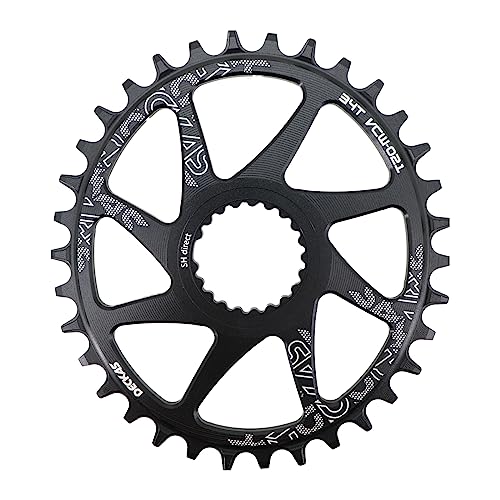
DJC Oval Direct Mount Chainring for Shimano 30T

DJC Direct Mount 3mm Offset Oval Chainring for Sram 30T

Andeshunk Bike Chainring 104BCD Narrow Wide 36T Oval

absoluteBLACK Oval 64BCD Narrow/Wide Chainring 26T
Taking A Closer Look At The Options
The DECKAS 36T oval ring suits riders converting a 104BCD crank to a single-ring setup for trail use. Its 7075 aluminum body with an anodized finish keeps weight low at 55 grams for this size, and the oval profile eases torque spikes on climbs. That combination makes it a straightforward choice for older Shimano or SRAM spiders.
Tooth shape does the retention work here. Alternating narrow and wide teeth grip the chain links more firmly, which helps on bumpy descents where drops happen. Compare that to the MSRECK options later in the list, and the DECKAS range stops at 38T while MSRECK extends higher.
Noteworthy Benefits
- 7075 aluminum construction keeps the ring light for long rides
- Oval shape smooths pedaling through steep sections
- Narrow-wide teeth hold the chain without a guide
- Works across 6 to 12 speed chains
- Anodized surface resists wear from regular use
Things To Consider
- 104BCD fit must be confirmed before ordering
- Tooth range tops out at 38T
The MSRECK 34T ring gives riders a middle gearing option for mixed terrain on a 104BCD spider. CNC milling and an anodized finish shape the 7075 T6 aluminum body, and the 4mm thickness sets a firm profile at the teeth. For most trail riders, that 34T size lands in a useful spot between climbing ease and cruising speed.
The wider size range sets this line apart from the DECKAS 36T pick above. Options run from 32T up to 52T, so the same mounting style covers gravel, road, and mountain setups. Tooth dimensions are listed as 1.9mm narrow and 3.7mm wide, a detail that explains the chain grip.
Where It Helps
- CNC machined 7075 T6 aluminum for durability
- Tooth range from 32T to 52T covers many builds
- Narrow-wide profile improves chain retention
- 49 grams at 34T keeps weight low
Worth Noting
- Single-ring use only, not for double or triple setups
- 104BCD measurement needs checking first
- Higher tooth counts suit flatter terrain
Who It Suits Best
Riders converting to 1x who want gearing flexibility across road and trail bikes.
Where Another Pick Suits Better
The DJC Oval Direct Mount Chainring for Shimano 30T suits modern Shimano direct mount cranks better than this bolt-on ring.
The 32T version of the MSRECK ring targets low-range climbing where a smaller ring keeps cadence spinning on steep pitches. At 41 grams, it is the lightest tooth count in the MSRECK weight list, and the same 7075 T6 aluminum construction carries over. That makes it a natural step down from the 34T MSRECK pick just reviewed.
Round and oval shapes are offered across the range, so the 32T choice can match a preferred pedal feel. The narrow-wide tooth design remains the retention feature, and compatibility spans 7 to 12 speed chains for Shimano, SRAM, and FSA cranks. One thing worth considering is whether 32T gives up too much top-end speed for flatter routes.
Positive Takeaways
- 32T size supports steep climbing gearing
- 41 gram weight at this tooth count
- Round or oval shape choice within the range
- Laser marking aids size identification
- CNC finished aluminum body
Trade Offs
- Smaller ring limits top speed on flat ground
- Single speed ring only, not for multi-ring setups
Made For
Trail riders who prioritize climbing control over flat-road speed.
Consider Something Else When
The absoluteBLACK Oval 64BCD Narrow/Wide Chainring 26T suits very steep technical terrain with even lower gearing.
This DECKAS 32T ring takes the same 104BCD approach as the first pick and pairs it with lower gearing for climbing. The 7075 aluminum body and anodized surface mirror the 36T version, and weight drops to 41 grams at 32T. That weight saving is small in absolute terms, yet it reflects the smaller diameter.
Use cases listed include mountain bikes, road bikes, BMX, fixie, and e-bikes, which signals broad single-ring compatibility. Larger wide teeth are highlighted for durability and chain drop resistance, a useful point on rough descents. The honest read is that this pick overlaps heavily with the first DECKAS ring, with tooth count as the main difference.
The Practical Payoff
- 32T gearing eases steep climbs
- 41 gram weight at 32T
- Wide tooth design supports chain retention
- Fits most Shimano and SRAM 104BCD cranks
Minor Gripes
- BCD must be verified before purchase
- Range limited to 32T to 38T
- Overlaps with the 36T DECKAS version
Direct mount changes the whole fitting picture, and this DJC ring is built for Shimano direct mount cranks rather than bolt-on spiders. Compatibility covers M6100, M7100, M8100, M8130, M9100, M9120, MT900, XTR, and SLX models. That list makes crank model checking the first step, not an afterthought.
The 3mm offset positions the ring for chainline alignment, and the hollow CNC design in 7075 aluminum keeps weight between 70 and 100 grams across 30T to 38T sizes. Narrow-wide teeth support 7 to 11 speed chains from any brand, with a specific note about Shimano 12 speed chains needing a non-Shimano quick link.
Real-World Strengths
- Direct mount fit for listed Shimano cranks
- 3mm offset aids chainline setup
- Hollow CNC aluminum design saves weight
- Narrow-wide teeth for chain retention
- 30T to 38T size range
Room For Improvement
- Shimano 12 speed chains need a different quick link
- Crank model must match the listed range
This DJC ring mirrors the Shimano version above but fits SRAM GXP three-bolt cranks instead. Listed models include XX1, XX1 Eagle, X01, X01 Eagle, X0, X9, X7, S2210, and S1400 in GXP and long-axis BB30 forms. Offset is the key decision here, since chainline depends on frame spacing.
The 3mm offset works with 135mm frames and Boost 148mm frames, and the ring supports 8 to 12 speed systems. Weight runs from 63 to 95 grams across 30T to 38T sizes in 7075 aluminum. For most SRAM riders, matching offset to frame type matters more than tooth count.
Positive Points
- SRAM GXP three-bolt direct mount fit
- 3mm offset for 135mm and 148mm frames
- 7075 aluminum hollow design
- 63g to 95g weight range
- Supports 8 to 12 speed systems
Small Caveats
- Offset must match frame spacing
- SRAM crank model needs confirmation
The Andeshunk 36T oval ring returns to the 104BCD bolt-on format shared by the DECKAS and MSRECK picks. CNC machining in aluminum alloy is the main construction detail, aimed at chain alignment and smooth running. In a busy workshop scenario, that machining claim is easier to verify by checking tooth alignment after fitting.
Compatibility covers single-ring setups with 8 to 11 speed chains, and the range spans 32T to 38T in round or oval shapes. That narrower chain range differs from the DECKAS 36T pick, which lists 6 to 12 speed support. The trade-off is simplicity against broader drivetrain coverage.
Strong Points
- CNC machined aluminum construction
- Round or oval shape choice
- Narrow-wide teeth for retention
Points To Note
- 104BCD fit is required, other patterns will not work
- Chain support limited to 8 to 11 speed
- Single-ring use only
Right Fit For
Newcomers to 1x conversions with 8 to 11 speed chains and 104BCD spiders.
Not Your Match When
The DECKAS Round Oval 104BCD 36T Narrow Wide Chainring suits wider chain ranges beyond 11 speed.
The absoluteBLACK ring breaks from the 104BCD pattern entirely with a 64BCD interface for four-bolt spiders. Tooth counts of 26T and 28T open low-range gearing for steep, technical terrain where control matters more than speed. On a long-haul climb with loose rock, that lower gearing keeps cadence steady.
CNC machined 7075 aluminum and a 46mm chainline are the supporting details, along with narrow-wide teeth for retention without a guide. The oval shape is presented as smoothing torque through the pedal stroke. Unlike the 32T MSRECK pick, this ring is aimed at a specific spider pattern and a specific climbing use case.
The Good Stuff
- 26T and 28T sizes for low-range climbing
- 64BCD fit for compatible four-bolt spiders
- CNC machined 7075 aluminum construction
- Narrow-wide teeth maintain chain security
- Oval profile smooths cadence on technical terrain
Honest Caveats
- 64BCD spider required, not 104BCD
- Low tooth counts limit flat-road speed
What Matters Most Before Choosing Alloy Oval Chainring
Mounting Pattern First
Matching BCD or direct mount interface prevents a ring that cannot be fitted. Bolt-on rings use 104BCD or 64BCD spiders, while direct mount rings lock to a specific crank family. Measuring the spider or checking the crank model saves a return trip.
Tooth Count For Terrain
Lower counts such as 26T to 32T suit steep climbs and technical trails. Higher counts up to 52T suit flatter road use where speed matters. Your typical gradient should drive the choice more than brand preference.
Chain Compatibility And Retention
Narrow-wide teeth grip the chain to reduce drops on rough descents. Speed range matters too, since some rings cover 6 to 12 speeds while others stop at 11. Checking chain speed against ring support avoids noisy running.
Material And Weight
7075 aluminum dominates this list for its strength to weight balance. Weights range from the low 40 gram range at small tooth counts to around 100 grams at larger sizes. That difference is modest, yet it adds up across a full build.
Key Considerations Across These Picks
Common Shopping Slip Ups
Ordering by tooth count alone causes most fit problems. BCD, direct mount model, and offset need checking before size. A quick measurement of the spider prevents the most common mismatch.
What The Higher Tier Buys
Higher tier rings often add specialized low-range sizes, tighter chainline control, and refined oval profiles. That extra work shows up in steep terrain where cadence smoothing matters. For flatter routes, a simpler 104BCD ring covers the same ground.
Frequently Asked Questions
What does BCD mean on a chainring?
BCD stands for bolt circle diameter and describes the spacing of mounting bolts on a spider. A 104BCD ring only fits a spider with matching bolt spacing.
What is a narrow-wide tooth design?
Alternating narrow and wide teeth grip chain links more firmly than uniform teeth. That grip helps keep the chain in place on bumpy terrain without a chain guide.
What is the difference between bolt-on and direct mount?
Bolt-on rings attach to a spider with bolts, while direct mount rings attach directly to the crank arm. Direct mount requires an exact crank model match.
What tooth count suits steep climbs?
Counts from 26T to 32T give lower gearing for steep gradients. Larger counts suit flatter terrain where higher speed matters more.
What does offset mean on direct mount rings?
Offset describes how far the ring sits from the crank arm. Matching offset to frame spacing keeps the chainline straight and reduces noise.
Final Verdict
Your best match depends on crank pattern first, then gearing for the terrain you ride most. The DECKAS 36T ring covers common 104BCD builds well, while the absoluteBLACK 26T ring suits steep technical climbs with a 64BCD spider. Check mounting details carefully and the choice becomes clear.