
A bicycle intercom solves a simple trail problem: shouting across wind, traffic, or a switchback rarely works. Riders spread out, a turn gets missed, and the group reforms slowly. A helmet-mounted system keeps conversation moving while hands stay on the bars, and that matters most on long road rides and technical singletrack. You need range that matches how far apart riders actually get, plus a mic that filters wind instead of amplifying it.
Mesh communication, meaning a network where units relay for each other rather than relying on one hub, helps larger groups stay linked. Bluetooth links a headset to a phone or computer for calls and navigation prompts. The picks below split by group size, weight, weather protection, and battery time, so the right choice depends on whether rides are usually a pair or a full club group.
The Main Contenders

Sena BiKom 20 Cycling Communication System 20 Grams

J-TREK BH03 Bluetooth 5.4 Helmet Headphone Dual Pack

J-Trek BH03 Bluetooth 5.4 Helmet Headphone Single Pack

Cycling Intercom Headset Waterproof Bluetooth Earpiece 520 Meter

Bicycle to Bicycle Intercom 520-Meter Bluetooth Headset IPX5
Cycling Intercom Headset 2-Pack Bluetooth 6.0 520M IPX5

Bluetooth 6.0 Bicycle Intercom System 2-Way 520m IPX5

Bluetooth Motorcycle Bike Intercom Headset 2Pcs 520M IPX5
The Details Behind The Selections
Weight shapes this pick more than any other detail. At 20 grams, the Sena BiKom 20 adds almost nothing to a road helmet or a cap, which suits riders who notice every extra gram on a long climb. The two-unit pack covers a pair straight away, with hat clip and strap mounts in the box.
Range reaches 0.5 mile with talk time up to 7 hours, and six channels let a larger group split conversation without crowding one line. Advanced Noise Control, a filtering system that reduces wind behind speech, helps on exposed descents. Over-the-air firmware updates, meaning software changes sent wirelessly, keep the units current without a cable.
A Strong Showing
- 20-gram main unit stays unobtrusive on light helmets
- Six channels support many riders across separate groups
- 0.5-mile range suits gaps on open roads and trails
- Advanced Noise Control improves speech clarity in wind
- Over-the-air updates avoid wired maintenance
Things To Consider
- 7-hour talk time runs shorter than 10 to 14-hour rivals
- Bluetooth 4.0 lags newer Bluetooth 5.4 and 6.0 links
Group size drives the appeal here. Eight riders can join one intercom, and the stated range reaches 1000 meters, or 0.62 mile, which stretches beyond the Sena BiKom 20 figure. That gap matters on rolling terrain where riders string out along a ridge. Bluetooth 5.4, a newer wireless standard for steadier phone and computer links, pairs with phones, GPS cycling computers, and speedometers.
Battery life reaches 14 hours of intercom use, with a 60-minute fast charge for rushed mornings. DSP, short for digital signal processing, and CVC noise reduction work together to cut wind and road sound, with clarity claimed up to 70 km/h. The clip-on mount fits bicycle, ski, and climbing helmets, so one set moves across sports. You get two units in the dual pack, ready for a partner.
Where It Excels
- Eight-way intercom keeps a full group in sync
- 1000-meter range handles wider spacing than 520-meter sets
- 14-hour battery suits all-day events and tours
- DSP and CVC filtering target wind noise at speed
- Clip mount moves between helmet types quickly
Worth Noting
- Dual pack suits pairs, while solo riders pay for a second unit
- Long range figures assume open conditions, not dense tree cover
Who It Suits Best
Club riders and tour groups who regularly ride with six to eight people on open roads.
Where Another Pick Suits Better
Sena BiKom 20 Cycling Communication System 20 Grams suits riders who value lower weight and mesh networking over raw range.
A single unit changes the math for a group that already owns headsets. This BH03 matches the dual pack on Bluetooth 5.4, eight-way intercom, and 1000-meter range, so adding one rider costs one unit instead of a pair. The 14-hour battery and 60-minute fast charge stay the same, which helps on century rides. In our view, that single-pack logic is the main reason to pick this version.
Weather protection sets it apart in the other direction. The listing marks this model as not water resistant, unlike IPX5-rated rivals, so rain rides need a cover or a different pick. DSP and CVC noise reduction still target wind at speed, and the clip-on mount fits most bicycle, ski, and climbing helmets.
The Value In It
- Single pack adds one rider without buying a pair
- 1000-meter range matches the dual-pack version
- 14-hour battery handles long group days
- Bluetooth 5.4 links phones and GPS computers
Trade Offs
- Not water resistant, so wet rides need extra care
- One unit means a partner still needs a matching headset
- Range drops in hills and heavy tree cover
Pair riding is the whole brief here, and 520 meters of two-way talk covers most road gaps between two people. Low latency, meaning minimal delay between speech and hearing it, lets riders talk without stopping at junctions. The sealed waterproof shell suits rain, snow, and sweat, which gives it an edge over the single BH03 on wet days.
Size measures 5.3 by 2.96 by 2.3 centimeters, with a 230mAh battery giving about 10 hours of talk or music. Bluetooth 6.0 handles pairing, and voice prompts help with calls and mode changes. Controls stay simple on the move, a plus for mountain bike helmets and ski helmets alike. For most trail rides, two-person range and weather sealing matter more than eight-way group features.
Standout Benefits
- 520-meter two-rider range for road and trail gaps
- Waterproof shell for rain and sweat
- About 10 hours from a 230mAh battery
Minor Gripes
- Single unit only, so a partner needs a second headset
- Two-person limit rules out larger group conversation
Made For
Pairs who ride year-round in wet climates and mainly talk to each other.
Consider Something Else When
J-TREK BH03 Bluetooth 5.4 Helmet Headphone Dual Pack suits groups larger than two who need eight-way talk.
At 18 grams, this single headset is lighter than the 20-gram Sena unit, and the clip snaps onto most helmet edges. IPX5 rating, a standard for resistance to water jets, covers rain, moisture, and sweat. Music sharing between two paired headsets sets it apart from the plain two-way talk on the previous pick, so both riders hear the same playlist.
The microphone arm rotates 120 degrees to sit close to the mouth, and noise-canceling processing cuts wind for clearer speech. A 230mAh battery gives up to 10 hours, with Type-C charging in about one hour. Size stays compact at 5.3 by 2.96 by 2.3 centimeters in PC and ABS plastic. One thing worth considering: a single unit still leaves a partner to buy a matching headset.
What Stands Out
- 18-gram weight keeps light helmets comfortable
- Music sharing lets two riders listen together
- 120-degree rotatable mic improves voice pickup
- Type-C charge reaches full in about one hour
Room For Improvement
- Single headset, not a ready-made pair
- 520-meter range trails the 1000-meter BH03
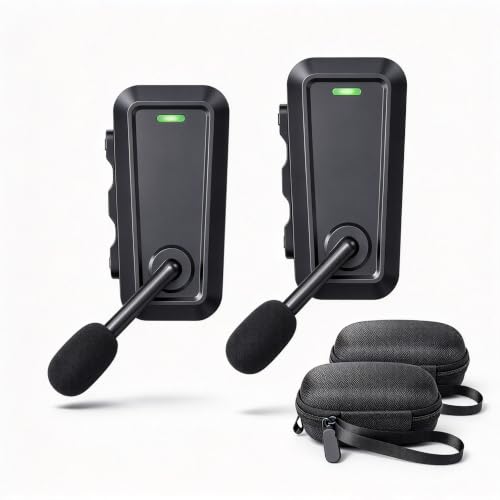
Two headsets plus two carry cases make this a ready pair out of the box, unlike the single units above. Each unit weighs 18 grams and uses Bluetooth 6.0 for two-way talk up to 520 meters. The IPX5 ABS shell resists rain, sweat, and splashes, and a detachable foam mic cover adds a layer of protection. Dual clips fit bike helmets, ski helmets, caps, and harnesses.
A 120-degree rotatable boom mic filters wind and ambient sound, and music sharing syncs playlists for both riders. The 230mAh battery gives 10 hours of talk or playback after a one-hour Type-C charge. Voice assistant control keeps hands free for calls and navigation. In most kitchens of thought, storage matters, and the included cases give each headset a home between rides. You can hand one headset to a partner without extra shopping.
Real Benefits
- Two headsets and two cases form a complete pair
- 18-gram units clip to helmets and caps
- Music sharing syncs both riders to one playlist
- Voice assistant control keeps hands on bars
- 10 hours of use after a one-hour charge
Points To Note
- Two-person design does not extend to eight-rider groups
Cross-brand intercom is the headline here. Riders with different headset brands can still talk two-way once paired, which helps mixed groups where nobody wants to match hardware. That mode covers intercom only, without music sharing or group chat, so expectations need to stay narrow. Bluetooth 6.0 pairs quickly and supports range up to 520 meters in open conditions.
An AI voice assistant handles calls, music, and commands without reaching for a phone. Advanced noise cancellation cuts wind and engine sound for clearer speech at speed. At 18 grams and 1.18 by 2.09 inches, the unit stays compact, with IPX5 water resistance for rain and sweat. Dual replaceable clips install without drilling or adhesive, and the main unit slides out to move between helmets.
Positive Takeaways
- Cross-brand two-way talk suits mixed groups
- AI voice assistant keeps hands on the bars
- Dual clips move between helmets without tools
- IPX5 rating covers rain, splashes, and sweat
Softer Spots
- Cross-brand mode excludes music sharing and group chat
- Single-unit focus leaves a partner to equip separately
- 520-meter range depends on open terrain
Right Fit For
Riders in mixed-brand groups who mainly need two-way conversation on the road.
Not Your Match When
Cycling Intercom Headset 2-Pack Bluetooth 6.0 520M IPX5 suits partners who want a complete pair with shared music.
Two pieces in one set answer the partner question directly, with 520 meters of two-way talk for open roads and trails. Low-latency transmission keeps speech flowing while moving, so riders avoid stopping to shout. The sealed IPX5 structure resists rain, snow, dust, sweat, and moisture, which suits riders who head out regardless of forecast.
A 120-degree rotatable mic arm adjusts to mouth position, and noise reduction filters wind and road sound for hands-free calls. The 230mAh battery gives up to 10 hours, with Type-C fast charging in one hour. At 18 grams, the clip-on design fits most sports, mountain bike, and ski helmets. You can share music between the two headsets, though that feature matters more on relaxed rides than on technical descents.
The Upside
- Two headsets cover a pair from the start
- IPX5 sealing handles rain, snow, and dust
- Rotatable mic arm targets clearer voice pickup
Small Caveats
- Two-person limit excludes larger group rides
- 520-meter range shrinks in built-up or wooded areas
What Matters Most Before Choosing Bicycle Intercom
Range Against Real Spacing
Group size sets the range need. Pairs often stay within 520 meters on open roads, while eight-rider groups spread farther and benefit from 1000-meter claims. Hills, buildings, and dense trees cut effective distance, so treat headline range as an open-area ceiling. You should match the figure to how far apart riders actually drift on typical routes.
Weight, Weather, and Battery
Weight matters on long climbs, where even 20 grams adds up over hours. IPX5 sealing helps in rain and sweat, while a non-water-resistant model suits dry climates only. Battery time ranges from 7 to 14 hours across these picks, so riders on century events need the longer end or a mid-ride charge plan.
Compatibility and Controls
Cross-brand talk helps mixed groups, while mesh systems suit riders who want one network for many people. Voice assistant control and rotatable mics reduce distraction at speed. Check helmet fit and clip style before ordering, since mount design varies by helmet edge and strap layout.
Key Considerations Across These Picks
Common Shopping Slip Ups
Shoppers often buy a single unit and forget a partner needs matching gear. Others assume headline range holds in forests and towns, where obstacles shorten links. Checking pack contents and helmet compatibility before ordering avoids both problems.
What The Higher Tier Buys
Higher-tier systems add mesh networking, more channels, and firmware updates sent wirelessly. Those features pay off for large clubs and frequent group rides. Pairs on casual weekends gain little from mesh complexity and do well with simpler two-way sets.
Frequently Asked Questions
How many riders can one intercom link?
Capacity varies by model, from two riders on pair sets to eight riders on the BH03 systems. Mesh models like the Sena BiKom 20 use six channels to separate several groups at once.
What range should a pair expect?
Pair sets list 520 meters in open areas, which covers most road spacing between two riders. Hills, buildings, and trees reduce that distance in real terrain.
Do waterproof ratings matter for cycling?
IPX5-rated headsets resist water jets from rain and sweat, which suits year-round riding. Non-water-resistant models suit dry-weather rides only.
How long does a charge last?
Talk time ranges from 7 hours on the Sena BiKom 20 to 14 hours on the BH03 systems. Most 10-hour models recharge in about one hour through Type-C.
Can different brands talk to each other?
Cross-brand two-way talk works on the Bluetooth 6.0 system listed here, without music sharing or group chat. Matching brands still give the widest feature set for shared music and larger groups.
Final Verdict
For large groups, the Sena BiKom 20 and the BH03 systems lead on networking and range. For pairs, the two-pack sets with IPX5 sealing and 10-hour batteries cover most needs with less complexity. Match group size, weather, and battery time to typical rides, and the choice narrows quickly.