Lumens measure brightness, with higher numbers meaning more light output for the road ahead. IPX ratings describe water resistance, where a higher number indicates stronger protection against rain and splashes. You ride into fading light with traffic nearby, and a front light helps you spot hazards while a rear light helps others spot you.
A road setup needs a clear beam for unlit stretches and a wide rear flash for intersections. Your handlebar and seatpost space also matters, because bulky mounts can crowd a computer or saddle bag. The picks below balance brightness, runtime, mounting, and rechargeable convenience for different riding styles.
A Snapshot Of The Selections

Malker Silicone LED Bike Light Set Front and Rear

3000 Lumens Bike Lights for Night Riding, Headlight Taillight Set

DON PEREGRINO Rear Bike Light 110 Lumens 5 Modes Red/Blue
EILIOC 6400mAh Bike Lights Headlight Taillight Set 1200 Lumen
NAGEVSEM Bike Lights Front and Back Rechargeable Set

Magicshine RN 1500S Bike Front Light
ROCKBROS Magnetic Bike Tail Light Rechargeable IPX6 7 Modes
Inside Each Recommended Option
Soft silicone bodies make this four-light set easy to move between bikes, helmets, and backpacks. You want a simple backup set for dawn starts or a second bicycle, and the strap-on fit suits that role. Each unit weighs 21 grams, so the added load stays negligible on a road bike.
Visibility reaches a half mile in low light, and three modes cover high, low, and strobe patterns. CR2032 button cells power each light, with runtime listed at 45 to 70 hours in steady use and up to 160 hours in flashing use. The trade-off shows up in beam strength, because this set signals presence rather than lighting an unlit road ahead.
Points In Its Favor
- Four lights split between white and red silicone bodies
- Tool-free strap fitting takes seconds on varied mounts
- Water-resistant silicone handles rain and road spray
- Spare placement options suit helmets and backpacks
- Replaceable button cells keep running costs predictable
Things To Consider
- Button cells need periodic replacement instead of USB charging
- Small output suits visibility more than road illumination
Two LEDs push output to 3000 lumens with a 500-foot beam distance, a clear step up from the Malker set for dark roads. You commute after sunset on unlit segments, and that reach helps spot debris and potholes sooner. An aluminum housing aids heat dissipation during long high-output runs.
A 5000mAh battery runs 3.5 hours at top brightness and 12 hours at the lowest setting. USB Type-C charging refills the headlight in 3 hours, while the taillight takes 0.5 hours, and the headlight can charge a phone in an emergency. In our view, the LCD percentage display removes guesswork before a long ride, though the 150mAh taillight battery limits rear runtime to 6 hours.
The Case For It
- 500-foot beam suits fast, unlit road sections
- LCD display shows exact battery percentage
- Headlight doubles as a phone power bank
- Long-press shutoff works from any mode
- Quick-release bracket fits 0.98 to 1.26 inch bars
Worth Noting
- Taillight runtime trails the headlight by a wide margin
- High output drains the battery in 3.5 hours
- IPX4 rating covers splashes, not heavy downpours
Blue steady, blue flash, and red-blue strobe modes set this rear-only light apart from standard red taillights. You already own a front light and want stronger daytime presence in traffic, and the 180-degree beam spreads light across lanes. Thirty-six COB LEDs, meaning chip-on-board arrays, deliver 110 lumens across that wide angle.
Visibility reaches 150 meters, and USB-C charging takes 2 hours for 4 to 10 hours of use. Two brackets cover saddle and seatpost fit on road, mountain, hybrid, and commuting bikes, with quick release for pocket carry. For most riders, that mounting flexibility matters more than raw output, though a front light must come from another pick in this list.
Everyday Advantages
- Blue modes stand out among red taillights
- 180-degree beam covers side approaches
- Two mounts fit saddle rails and seatposts
- USB-C charging simplifies cable sharing
Small Caveats
- Rear light only, so a front light is still needed
- Saddle bracket needs its two screws tightened before use
Who It Suits Best
Commuters who already own a front light and ride busy roads in daylight.
Where Another Pick Suits Better
Magicshine RN 1500S suits riders who need a front beam with a defined cutoff.
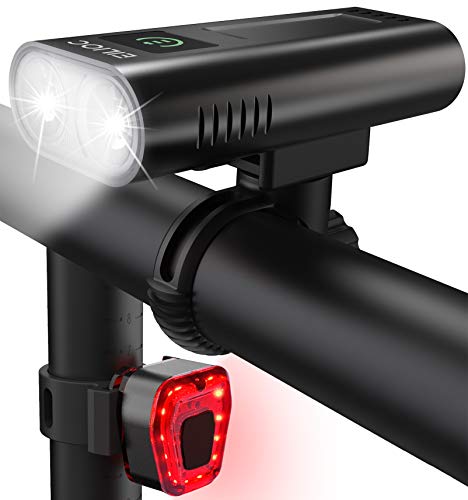
An aluminum alloy shell and 6400mAh battery give this set a tougher, longer-running profile than the lighter silicone option. You need steady light for a two-hour evening loop, and the headlight runs 5 plus hours at 1200 lumens or 11 plus hours at low output. A 100-meter irradiation distance keeps road texture visible without the extreme output of the 3000-lumen set.
USB Type-C input charges the large battery in 6 hours, and the headlight can serve as a power bank for a phone. The bracket rotates 360 degrees and fits handlebars from 28 to 44 millimeters, which covers most road bars. The honest read is that charging time grows with capacity, so a nightly top-up routine suits this pick better than occasional charging.
Where It Excels
- 6400mAh capacity supports long evening rides
- Aluminum shell resists sun and rain exposure
- Rotating bracket aims light precisely
- Power bank function adds emergency backup
- Tool-free fitting covers wide handlebar range
Points To Note
- Six-hour charge time needs planning ahead
- Larger battery adds weight versus compact sets
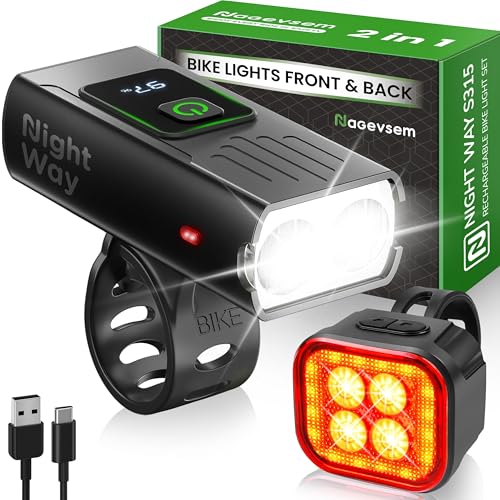
Dual T6 LEDs and a 500-foot beam put this set in the same long-range conversation as the 3000-lumen option, with a rotating head for aiming. You switch between road and trail surfaces, and 360-degree rotation lets the beam follow a descent or a tight turn. A digital display shows battery level at a glance.
The front light charges in 3 hours via USB-C, while the rear light charges in 1.5 hours and runs up to 33 hours. Twenty rear LEDs produce 50 lumens across a 270-degree view, and silicone straps mount without tools. Assuming a standard road cockpit, the rotating head adds flexibility, though mode counts differ between front and rear in a way that takes a little practice to learn.
The Practical Payoff
- Rotating head aims beam for varied terrain
- Rear runtime reaches 33 hours
- Digital display tracks charge level
- Silicone straps fit without tools
- Aluminum housing resists impacts
Trade Offs
- Separate front and rear mode counts add learning time
- IPX4 rating suits rain, not submersion
- Rear output stays modest at 50 lumens
Made For
Riders mixing road, trail, and commuting routes on one bicycle.
Consider Something Else When
EILIOC 6400mAh set suits riders who prioritize battery capacity over beam rotation.
A Luminus SST-40 LED delivers 1500 lumens over 199 meters through a PC optical lens. You run fast group rides on dark roads, and the defined cutoff puts light on pavement instead of into oncoming eyes. Five modes span 300, 750, and 1500 lumens steady, plus night and daytime flash patterns.
A 5000mAh battery runs up to 16 hours on low, and Type-C charging refills in about 1.5 hours with an 18W charger. A wireless remote switches modes without leaving the bars, and a GoPro-style under-mount keeps the cockpit clear for a computer. The catch is simple, because this is a front light only and a taillight must come separately.
Practical Advantages
- Anti-glare lens shapes a defined road beam
- Remote control keeps hands on bars
- Under-mount frees space for a computer
- Mode memory restores the last setting
- Lockout prevents accidental bag activation
- Power bank tops up phone or computer
Honest Caveats
- Front light only, with no taillight included
- Shim fit must match handlebar diameter
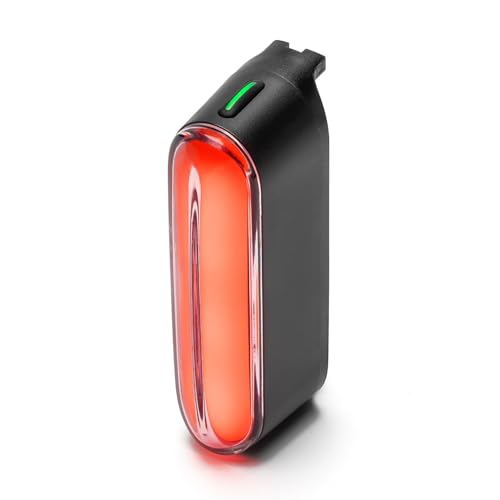
A magnetic mount snaps on in seconds without tools, which makes this rear light easy to remove for charging or storage. You stop at lights often in traffic, and the brake sensor triggers a high-intensity flash for 1.5 seconds when speed drops. A long strip with fan-shaped layout gives visual distance up to 656 feet.
Seven modes include single flash, double flash, strobe, water drop flash, breathing flash, back and forth flash, and steady-on. Automatic mode sleeps in daylight and wakes with vibration, while single flash mode runs up to 36 hours. Indicators flash at 30 percent and 10 percent battery, so a long ride rarely ends with a surprise.
What Stands Out
- Magnetic fitting removes and replaces in seconds
- Brake sensor flashes when slowing down
- Auto mode sleeps in daylight, wakes on vibration
- 36-hour runtime in single flash mode
- IPX6 rating handles heavy rain exposure
Points To Keep In Mind
- Rear light only, so pair with a front light
- Magnetic contact needs a clean mounting surface
What Matters Most Before Choosing Road Cycling Lights
Beam Shape and Brightness
High lumen counts help on unlit roads, while a defined cutoff keeps light on pavement. You check beam distance alongside output, because a bright but scattered beam wastes light. Road riders benefit from a shaped pattern, and commuters benefit from wide side visibility at junctions.
Runtime and Charging
Battery capacity decides whether a light lasts a short spin or a full evening loop. USB-C charging speeds turnaround, and a display or indicator removes guesswork. Larger batteries add weight, so capacity needs to match planned ride length.
Mounting and Cockpit Space
Handlebar diameter, seatpost shape, and computer mounts all affect fit. Quick-release brackets and silicone straps speed installation, while under-mounts keep the top of the bars clear. Measure the bar before ordering, and confirm that a saddle mount clears a bag or rack.
Water Resistance
IPX4 covers splashes and rain, IPX5 adds stronger spray protection, and IPX7 suits heavier exposure. Rainy-region riders gain from higher ratings, while dry-climate riders can prioritize beam and runtime. Housing material also matters, because aluminum sheds heat and resists impacts better than thin plastic.
Key Considerations Across These Picks
Common Shopping Slip Ups
Chasing the highest lumen number alone often leads to short runtime or a messy beam. Skipping handlebar measurements causes mount problems, and ignoring rear runtime leaves a bright front paired with a fading taillight.
What The Higher Tier Buys
Higher-tier models add shaped lenses, remote controls, and faster charging through Type-C ports. Those features pay off on long night rides, while casual evening loops gain little from extra complexity.
Frequently Asked Questions
How bright should a road cycling front light be?
Brightness depends on road lighting and speed, with 1200 to 3000 lumens covering most unlit routes in this list. Beam distance matters alongside lumens, because reach determines hazard spotting time.
Can a front light charge a phone?
Several picks in this list can charge a phone through a USB port. You can use that function as emergency backup, though charging a phone reduces light runtime.
What IPX rating suits rainy riding?
IPX4 handles splashes and light rain, while IPX5, IPX6, and IPX7 add stronger protection. Heavier rain exposure calls for a higher rating, and housing material affects impact resistance.
How long does a rechargeable bike light take to charge?
Charging times range from 0.5 hours for a small taillight to 6 hours for a large headlight battery. Type-C input and charger wattage affect speed, so check the stated charge time before a long ride.
Should a taillight have a brake sensor?
A brake sensor adds value in stop-start traffic by flashing when speed drops. Riders on open roads gain less from that feature, while commuters gain clear signaling at junctions.
Final Verdict
For a complete road setup, the 3000-lumen set covers brightness and charging in one package. Riders who value a shaped beam and remote control should look at the Magicshine front light, and riders who value simple rear signaling should consider the magnetic ROCKBROS taillight. Match beam, runtime, and mount fit to the routes ahead, and the right choice becomes clear.