
A dark commute home, a wooded trail after sunset, or a quiet road beyond streetlights all demand a front light that does more than glow. Beam spread, battery life, mounting, and weather resistance decide whether a light helps you see the road and helps drivers see you. The seven sets below cover commuters, trail riders, and computer-mounted setups, with trade-offs noted for each.
A Quick View Of The Lineup
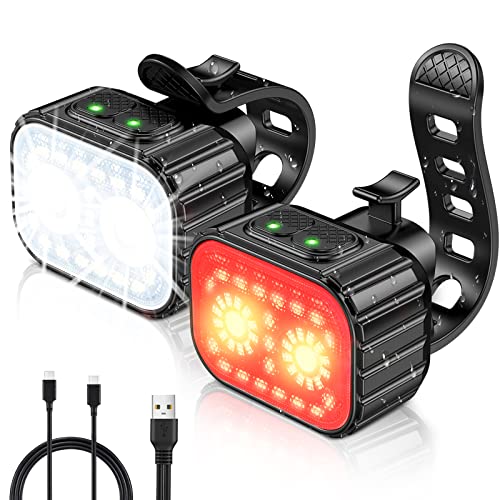
Cuvccn Bike Lights Super Bright Rechargeable Set

RAVEMEN FR1100 SE/FR500 Bike Headlight 270° Wide-Angled

Zewdov Bike Lights for Night Riding Rechargeable Taillight

Bike Lights for Night Riding Rechargeable Bicycle Taillights 9 LED

Zewdov High Lumen Super Bright Bike Lights Front and Rear

Ascher Ultra Bright USB Rechargeable Bike Light Set

Cuvccn Bike Lights Super Bright Rechargeable Bicycle Lights Set
More Details On Our Top Picks
Night commuters who want a front and rear pair in one box get a clear starting point here. Each unit combines two main LEDs with nineteen auxiliary LEDs, and separate switches let the front and rear run in different patterns. That split control matters on a shared commute, where steady front light and flashing rear light serve different jobs.
The front battery is 1100mAh, and slow flash stretches use to 58 hours, while the rear 350mAh cell reaches 25 hours in the same mode. A green indicator flashes below 20 percent charge, giving a practical warning before a ride. For most commuters, that long low-power runtime reduces charging frequency.
Features That Help
- Front and rear lights included as a matched set
- Independent switches allow separate mode choices
- Low-battery indicator appears below 20 percent
- IPX6 rating suits rain and foggy conditions
- Tool-free buckle mounting adjusts horizontally or vertically
Things To Consider
- Longest runtime applies only to slow flash, not high brightness
- Recharging is recommended after three months without use
Urban riders who already use a cycling computer get a cleaner cockpit setup here. The FR500 version provides up to 500 lumens in solid mode, and a 270-degree viewing angle spreads light toward side approaches at junctions. That wide spread differs from the narrower trail focus of the Zewdov High Lumen set.
Compatibility covers Garmin out of the box, with included parts for Wahoo and a separate QTM04 mount for Bryton. Auto on and off mode removes the common lapse of leaving a light running after a ride. You can also charge while using the light, a useful detail for a long commute. Aluminum alloy construction and six air guide grooves help manage heat during extended use, and weight is 101g.
Strengths Worth Knowing
- 270-degree angle improves side visibility at intersections
- Auto on and off reduces forgotten light drain
- Works with Garmin, Wahoo, and Bryton computers
- Lightweight 101g body suits a clean cockpit
Worth Noting
- Out-front mount is not included in the package
- Bryton use requires the separate QTM04 mount
Who It Suits Best
Road cyclists with Garmin, Wahoo, or Bryton computers who ride in city traffic.
Where Another Pick Suits Better
Zewdov High Lumen Super Bright Bike Lights Front and Rear suits dark trail riders needing a longer, focused beam.
Weight matters on a climbing bike or a folding bike, and this set answers with a 27g, 1.7cm-thick profile. The slim shape slips into a pocket after a ride, which helps when a light needs to come off for charging or storage. In our view, that portability is the main appeal here.
Both lights charge together in 1 to 1.5 hours through a 2-in-1 USB cable, and the headlight offers four modes while the taillight offers six, with memory of the last setting. Elastic rubber straps mount front and rear without tools. Your handlebar diameter still needs a quick check before ordering, since strap fit depends on the frame and post shape.
What Helps Most
- 27g weight keeps added load minimal
- Both lights charge simultaneously in about 1.5 hours
- Memory function restores the last mode
Trade Offs
- Elastic straps need a fit check on unusual post shapes
Mode variety is the headline here, with nine settings on each light covering strip only, center only, and full light in low, high, and flash. Last-mode memory means a regular commute starts in the same setup each time. That convenience differs from the simpler four-mode Ascher set, where fewer choices keep control basic.
Each light carries a non-detachable 750mAh battery, with runtime from 4 to 20 hours depending on mode, and a dual-head USB cable charges both in about 2.5 hours. Silicone straps install without tools on bikes, eBikes, and scooters. You get about 1.2 oz per light, so the pair stays light on a road bike. ABS and PS housing handles rain and splashes for everyday use.
A Favorable Mix
- Nine modes per light for different road conditions
- Last-mode memory saves repeated switching
- Dual-head cable charges both lights together
- Silicone straps remove quickly for charging
- Lightweight build suits road and scooter use
Minor Gripes
- Runtime drops to 4 hours in higher modes
- Nine modes may feel excessive for simple commutes
- Batteries are built in and cannot be swapped
Dark trails call for reach, and this headlight claims 1000 lumens with a focused beam visible up to 650 feet, plus eight auxiliary floodlights for wider coverage. That combination suits unlit paths where potholes and roots hide beyond a short pool of light. It stands apart from the RAVEMEN model, which prioritizes side visibility in traffic over distance.
The front battery is 2000mAh, giving up to four hours at highest brightness and 19 hours at lowest, while the rear 350mAh cell reaches 50 hours. Charging takes two hours for the headlight and one hour for the taillight through a two-port USB-C cable. Aluminum alloy casing, IP65 rating, and shock resistance support rough handling. Mode changes use single-click, double-click, and long-press, so the manual matters here.
Key Advantages
- 1000-lumen headlight with wide auxiliary floodlights
- 2000mAh front battery for longer high-brightness use
- Aluminum alloy casing aids heat dissipation
- IP65 rating handles heavy rain
Room For Improvement
- Three gesture types for mode changes need learning
- Highest brightness lasts up to four hours only
First-time night riders benefit from controls that stay simple under pressure. A single button cycles through full brightness, half brightness, slow flashing, and fast flashing, so changing modes in traffic takes little thought. The front light rotates 360 degrees horizontally, and the rear light tilts 45 degrees up and down for aiming.
The front 2000mAh battery runs 5 to 12 hours by mode, and the rear 330mAh battery runs 9 to 16 hours. Silicone straps with four openings fit most handlebars and seat posts, and the whole set weighs 3.5 oz. Your route length matters for mode choice, since full brightness drains the front cell faster than flashing modes. IPX4 rating covers rain, snow, and mud splashes.
A Strong Showing
- One-button control across four clear modes
- Front light rotates 360 degrees for aiming
- Silicone straps install in seconds without tools
Points To Note
- IPX4 offers less water protection than IPX6 sets
- Full brightness limits front runtime to the lower range
Made For
New cyclists and casual riders who want straightforward night visibility.
Consider Something Else When
Cuvccn Bike Lights Super Bright Rechargeable Set suits commuters needing longer slow-flash runtime and IPX6 protection.
Beam shape gets special attention here, with a white spotlight LED paired with eight yellow floodlight LEDs. Switching between high and low beams balances distance vision with close-range spread, a mix that suits roads that shift between lit streets and dark stretches. It differs from the first Cuvccn set, which uses a larger auxiliary LED ring instead.
The front light offers eight modes and the rear offers seven, with memory of the last setting. A dual USB-C cable charges both lights in 1.5 hours, and slow flash gives up to 16 hours front and 50 hours rear. You can carry the 32g unit as an emergency flashlight for camping or a power outage. IP65 rating and shock-resistant construction support rainy rides.
Notable Upsides
- Spot and flood LEDs cover distance and width
- Eight front modes and seven rear modes
- Dual USB-C cable charges both in 1.5 hours
- 32g weight aids pocket carry
- Memory function restores the last mode
Softer Spots
- Slow flash runtime is shorter than the first Cuvccn set
- Recharging is recommended after three months unused
What To Check Before Picking Front Lights For Cycling
Beam Shape And Spread
A focused spot beam reaches farther down a dark road, while flood or wide-angle light helps at junctions and on trails. Lumen figures alone do not describe spread, so match the pattern to the route. Urban riders gain from side visibility, and trail riders gain from distance.
Battery Life In Real Rides
Runtime ranges swing widely by mode, with slow flash lasting far longer than high brightness. Check the stated hours for the mode planned for daily use, not the longest figure alone. Your charging routine matters too, since a dual cable that charges both lights at once cuts downtime.
Mounting And Fit
Strap mounts suit most handlebars, while computer mounts need compatible hardware and sometimes a separate adapter. Weight and thickness affect cockpit clutter and pocket storage on longer rides. A quick diameter check before ordering prevents a loose or incompatible fit.
Key Considerations Across These Picks
Common Shopping Slip Ups
Chasing the highest lumen number often leads to a narrow beam that misses side traffic. Checking runtime only in slow flash also misleads, since high brightness drains a battery much faster. Matching the mount to the handlebar or computer setup avoids returns.
What The Higher Tier Buys
Higher-tier models add computer compatibility, auto on and off, wider angles, and aluminum housings for heat management. Those features pay off for daily urban riders and trail riders on unlit routes. Simple commuters gain less from extra modes and mounts.
Frequently Asked Questions
What beam pattern suits city commuting?
A wide-angle pattern helps drivers notice a cyclist from the front and sides at intersections. The RAVEMEN model uses a 270-degree angle for that purpose, while floodlights add close-range spread.
How long does a rechargeable front light last?
Runtime depends heavily on mode, ranging from a few hours on high brightness to dozens of hours on slow flash. Check the hours listed for the specific mode planned for regular rides.
Can one set cover front and rear needs?
Most sets here include both a white front light and a red rear light in one package. Separate switches or mode memory help keep front and rear patterns suited to their roles.
What water rating matters for rainy rides?
IPX6 and IP65 ratings both signal protection against rain and splashes, with the exact level differing by model. A sealed charging port cover also helps keep moisture away from the circuit board.
How do you choose a mount for a cycling computer?
Compatibility varies by brand, and some setups need included adapters or a separate mount. Checking Garmin, Wahoo, or Bryton support before ordering prevents an incomplete cockpit setup.
Wrap Up
For computer-mounted urban riding, the RAVEMEN model stands out for its wide angle and auto function. Trail riders should look at the Zewdov High Lumen set for reach, while commuters valuing long slow-flash runtime should consider the first Cuvccn set. Match the beam, mount, and runtime to the route ahead, and the right choice becomes clear.