
Dark commutes bring a simple problem: drivers and other riders need to spot a cyclist early, while the road ahead needs enough light to read hazards. A front and rear set solves both parts, and rechargeable power removes disposable batteries from the routine. You need coverage that stays charged through a full week, mounts without tools, and keeps working in rain. The six sets below cover slim carry, long runtime, brake sensing, and wide beams for different routes.
How The Shortlist Stacks Up
Cuvccn Bike Lights Super Bright Rechargeable Bicycle Lights Set Multiple Modes

Zewdov Bike Lights for Night Riding Rechargeable Taillight

Ascher Ultra Bright USB Rechargeable Bike Light Set

Zewdov High Lumen Super Bright Bike Lights for Night Riding
ROCKBROS Bike Tail Light Smart Brake Bicycle Rear Lights Rechargeable

Super Bright 7800Lumen Bike Light 6 LED Headlight Taillight Set
Taking A Closer Look At The Options
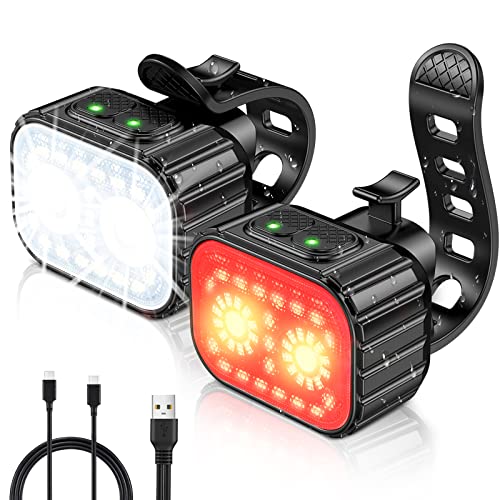
Mode choice is the main appeal here for your daily route. Each unit pairs 2 main LEDs with 19 auxiliary LEDs, and separate switches let front and rear patterns run alone or together. That setup suits riders who switch between lit streets and darker stretches without stopping to reconfigure.
Runtime matters most on a commute, and the numbers are strong in slow flash: up to 58 hours up front and 25 hours at the rear. A green flash below 20% charge gives a clear prompt to recharge before a morning ride. The honest read is that high brightness will drain the 1100mAh front cell far sooner than that slow-flash figure.
Well-Handled Touches
- Front has 4 modes and rear has 6 modes for day or night visibility
- IPX6 sealing plus a silicone cover over the USB port for rainy rides
- Tool-free buckle mounting that adjusts horizontal or vertical
- Memory function returns to the last mode used
- USB-C charging in about 2.5 to 3 hours
Things To Consider
- Rear battery is 350mAh, so rear runtime trails the front by a wide margin
- Many mode combinations add learning time before a ride
Weight is the story with this slim set. At 27g and 1.7cm thick, the units add almost nothing to a road bike, and the shape slips into a pocket after a ride. Unlike the Cuvccn set, this pair trades a large LED array for portability.
You can charge front and rear together in 1 to 1.5 hours through a 2-in-1 cable, which fits a short evening turnaround. The headlight offers 4 modes and the taillight 6, including a breathing flash that stays less harsh for riders behind. Battery retention reaches up to 7 months, though a charge after 3 months idle keeps performance sharp.
Advantages To Know
- Ultra-slim profile reduces bulk on handlebar and seat post
- Simultaneous charging cuts cable clutter at home
- IP65 rating covers rain and fog on short trips
- Elastic straps mount without tools on bikes, scooters, or strollers
Worth Noting
- Small body leaves less room for a wide, high-output beam
- Elastic strap fit needs a check on thicker seat posts
Who It Suits Best
Commuters on lightweight road bikes who value low bulk over maximum beam width.
Where Another Pick Suits Better
Zewdov High Lumen Super Bright Bike Lights suit riders on unlit roads who need a stronger front beam.
Simplicity defines this set for your first commuter setup. One button cycles full brightness, half brightness, slow flash, and fast flash, so switching modes at a traffic light takes no thought. The front light rotates 360 degrees horizontally, and the rear tilts 45 degrees up or down.
Battery figures split clearly by unit: the 2000mAh front runs 5 to 12 hours by mode, while the 330mAh rear runs 9 to 16 hours. That balance keeps the rear going longer in flash modes, which helps in busy traffic. At 3.5oz total, the pair stays easy to move between bikes.
Everyday Wins
- One-touch control suits new riders and shared family bikes
- Adjustable angles aim light toward road or traffic
- Silicone strap with four openings fits most handlebars and seat posts
- IPX4 rating covers rain, snow, and mud splashes
Trade Offs
- Four modes offer less tailoring than the Cuvccn or Zewdov high-lumen sets
- IPX4 sealing trails IPX6 and IP65 ratings on heavier downpours
- Front runtime drops to 5 hours at full brightness
Beam reach sets this Zewdov set apart on dark roads. The headlight runs at 1000 lumens, a measure of total visible light output, with 8 auxiliary floodlights widening coverage. Visibility is listed up to 650 feet, which suits long, unlit stretches where the Ascher set would feel narrower.
You get 8 front modes and 7 rear modes, controlled by single click, double click, or long press. That control scheme takes practice, and the manual becomes part of setup. In our view, the trade-off pays off for riders who regularly leave lit streets behind.
Good Reasons To Consider
- Aluminum alloy shell aids heat dissipation and resists shocks
- Front runs up to 4 hours at highest brightness and 19 hours at lowest
- Rear 350mAh cell runs up to 50 hours
- Two-port USB-C cable charges front in 2 hours and rear in 1 hour
- IP65 sealing handles heavy rain
Minor Gripes
- Three gesture types for mode changes add a learning curve
- High brightness cuts front runtime to 4 hours
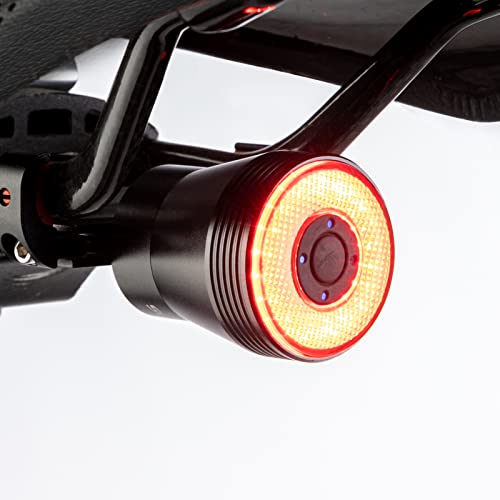
This is a rear-only light, and that focus shapes its appeal for your stop-and-go commute. A COB LED, a type of chip-on-board emitter that spreads light across a panel, pairs with brake sensing that flashes high intensity for 5 seconds during slowing. Drivers behind get a clearer signal at junctions than a steady rear light gives.
Motion and light sensors switch the unit off after 30 seconds idle and back on with movement in modes 1 and 2. Modes 3 and 4 bypass the light sensor for daytime visibility, while brake sensing stays active in all modes. Aluminum alloy construction and IPX6 sealing suit year-round traffic riding.
Practical Advantages
- Brake flash adds visibility at stops and turns
- 400mAh battery runs up to 50 hours on a charge
- Four blue indicators show charge in 25% steps
- Metal under-seat mount or rubber seat-post band included
Room For Improvement
- No front light included, so a separate headlight is needed
- Auto on-off applies only to modes 1 and 2
Made For
Urban commuters who already own a front light and ride through frequent stops.
Consider Something Else When
Ascher Ultra Bright USB Rechargeable Bike Light Set suits riders who need front and rear lights in one set.
Width is the headline here. Six LEDs in a horizontal layout give 270-degree illumination, and the bracket rotates 360 degrees so the beam can angle toward a turn or a trail edge. You can aim that spread without removing the mount, which helps on mixed routes.
Runtime is listed up to 72 hours, and the front unit can also charge a phone or another device. Modes split 5 and 5, with SOS on the front and red, blue, and flashing patterns on the rear. Anodized aviation aluminum and IPX6 sealing give the shell a tougher feel than plastic-bodied sets.
Points In Its Favor
- Wide beam covers side hazards beyond a narrow spot beam
- 360-degree bracket adjusts aim in about 3 minutes of setup
- Rear light reflects light when power runs out
- Green and red indicators show charge ranges at a glance
- Two charging cables included in the set
Points To Note
- Blue rear modes suit visibility over standard red-only signaling
- 72-hour runtime depends on low modes, not high output
Factors That Shape A Commuter Light Choice
Brightness And Beam Shape
Lumens describe total output, while beam shape decides where that output lands. A focused beam reaches far down an unlit road, and a wide beam covers junctions and side streets. Your route decides which shape earns its place, since city riding rewards width and rural riding rewards reach.
Battery Runtime And Charging
Runtime figures depend on mode, so slow flash and high brightness sit at opposite ends of the same battery. Check the milliamp-hour rating, shortened to mAh, to compare front and rear cells across sets. USB-C charging shortens turnaround, and a low-charge indicator helps prevent a dead light mid-commute.
Weather Resistance And Mounting
IP ratings describe protection against water and dust, with higher numbers handling stronger exposure. Tool-free straps and brackets matter for riders who move lights between bikes or store them indoors. A secure mount also keeps the beam aimed correctly over rough pavement.
Key Considerations Across These Picks
Common Shopping Slip Ups
Comparing runtime without checking the mode behind the figure leads to short expectations. A 50-hour claim in slow flash will not match high brightness use. Check front and rear ratings separately before deciding.
What The Higher Tier Buys
Aluminum shells, wider LED arrays, and brake sensing add cost through materials and extra electronics. Those additions pay off on unlit roads and in heavy traffic. Lit, short routes gain less from the same upgrades.
Frequently Asked Questions
How bright should a commuter bike light be for city streets?
City streets need clear visibility more than long reach, so a moderate front beam plus a flashing rear light covers most routes. Wider beams help at junctions where side traffic appears.
How often should a rechargeable bike light be charged?
Charge intervals depend on mode and battery size, with slow flash lasting far longer than high brightness. A low-charge indicator gives a practical cue to plug in before the next ride.
Are IPX6 and IP65 ratings different for cycling?
Both ratings cover strong water exposure, with IPX6 aimed at powerful jets and IP65 aimed at dust and water jets. Either rating suits rainy commutes, and the shell material affects heat and impact handling.
Can one light set fit different bikes?
Elastic straps and rubber bands fit most handlebars and seat posts, including scooters and strollers in some sets. Measure bar diameter and post shape before mounting on a new bike.
Is a brake-sensing rear light worth it?
Brake sensing helps in stop-and-go traffic by flashing brighter during slowing. Riders on steady-speed paths gain less from that feature than commuters at frequent junctions.
Final Verdict
Zewdov High Lumen Super Bright Bike Lights suit unlit roads, while Zewdov Bike Lights for Night Riding suit light bikes and short trips. ROCKBROS Bike Tail Light Smart adds brake sensing for busy traffic. Match beam, runtime, and mounting to your route, and the right set becomes clear.